

 .
.  .
.  .
. 
 .
. 
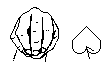 the hand-shape-sign:
Touch the fingertips to each other
like wrapping an egg downward:
the shape of covering and protecting a growing important
thing inside.
You might feel that the internal space is filled
by energy from the top: the center of the palm.
(卵を上から包むように、全指先をひとつに合わせる。
この手の頂上、手のひらの中心から内部空間に満ちてくるエネルギーが感じられるだろう。)
the hand-movement-sign:
Draw the base shape in
one stroke starting from the bottom joint (下の接合部から書き始める)
name:  [a] ( the same vowel to this phonetic function) ( ア )
ASCII: A (the similar looking shape)
phonetic value:
[a]: front-open vowel (the base symbolizes the large opened mouth) (母音で前舌のア)
definition (single):
as the upside-down shape of 'heart', it means a life/ lives. (命、生)
verb:
vi. live (生きる)
main images in base overlays:
1) Related to the body or a part of a human/animals (人や動物の体とその一部に関連)
2) General terms about conditions/quality/needs of 'a life' (命のいろんな状態や質などの一般概念)
3) Related to a process of life (生きる過程)
4) Related to Relations of lives (世代関係/男女・雌雄・親族の区別)
5) Related to various living creatures and organic things (いろんな生物・有機物)
6) To form a picture-like fundamental character for 'fruit' ( 「果実」を示して象形文字の構成)
examples of base overlay:
Related to the body or a part of a living thing (生物の体とその一部に関連) {67,50(tangible thing)}: body (of a living creature) (身体)
 {67,50(body)16(part)}:
body part/parts of a living thing (身体の部分)
{67,50(body)16(part)}:
body part/parts of a living thing (身体の部分) {67(life),32}: individual of life (生命個体)
 {67,69(torso shape)}: torso; sit (vi. with #gd:
support torso without depending upon legs)
{67,69(torso shape)}: torso; sit (vi. with #gd:
support torso without depending upon legs) {67,69,62(back)}: back (of torso) (背中)
 {torso,
62back,
{torso,
62back,  {04,39}
mouth} or
{04,39}
mouth} or  :
anus/vent (肛門)
:
anus/vent (肛門) {67,69,61(front)}: stomach (腹)
 {67,69,19(in)}: internal organ/bowel/entrails/ guts (内臓)
 {67,69, 62,18(under)}: bottom (尻)
 {15,{67,69}(torso)}: breast (胸)
 {67,69,01(dot)} (a dot in
the middle of torso): navel (臍)torso, 62back, {04,39}
mouth}: anus/vent
(肛門)
{67,69,01(dot)} (a dot in
the middle of torso): navel (臍)torso, 62back, {04,39}
mouth}: anus/vent
(肛門)
 {59(liquid),67}: body fluid (any kinds including
blood and lymph)(体液)
{59(liquid),67}: body fluid (any kinds including
blood and lymph)(体液) {42,59,67}( flowing 42) liquid(59) (in a living
thing)}: blood(血)
{42,59,67}( flowing 42) liquid(59) (in a living
thing)}: blood(血) {42,59,67,20(out)}: bleed (with gd) (出血)
 {{33,23}(color) 67(a part of 'blood')}: red (赤)
 : {15,59(liquid),67}({15,(67)}(as the symbol of breasts
of mother)}: milk (乳)
: {15,59(liquid),67}({15,(67)}(as the symbol of breasts
of mother)}: milk (乳) {{15,59,67}(milk),{(67),02,21}(fermentation)}: yogurt (ヨーグルト)
 {{15,59,67}(milk),{(59),52,44}(oil)}: butter
(バター)
{{15,59,67}(milk),{(59),52,44}(oil)}: butter
(バター) {{15,59,67}(milk),36( time ),25(joined)}:
cheese (チーズ)
{{15,59,67}(milk),36( time ),25(joined)}:
cheese (チーズ) {{15,59,67}(milk),{(59),24}(ice)}: ice-cream (アイスクリーム)
 {43(for stickiness),{15,59,67}(milk)}: cream
(クリーム)
{43(for stickiness),{15,59,67}(milk)}: cream
(クリーム) {{15,59,67}(milk),50(goods)}: dairy product
(乳製品)
{{15,59,67}(milk),50(goods)}: dairy product
(乳製品) {46(function),67}: organ of living creature (器官)
 {47(accept),46,67}: digestive organ (消化器官)
 {40(balance),46,67}: the organ system for controlling hormone (ホルモン器官)
 {70,{46,67}(organ)}:
respiratory organ (呼吸器官)
{70,{46,67}(organ)}:
respiratory organ (呼吸器官) {01(dot/tiny elements),67}: cell of any body of lives (細胞)
 {{01,67}(cell),28(sheet)}: cell membrane (細胞膜)
 {16(separated), {01,67}(cell)}: segmentation of cell (細胞分裂)
 {67,28(surface/sheet)}: membrane (膜)
 {67,28,20(out)}: skin (皮膚)
 {67,24(hard)}: shell/carapace (殻)
 {67,24,10(place)}: shelter (シェルター)
 {34(substantial part),67(animal life)}: meat (肉)
 {34,67,07(much)}: fat/plump/fleshy (太った)
 {34,67,08
less}: thin/ lean (痩せた)
{34,67,08
less}: thin/ lean (痩せた) {{34,67},47
accept}: carnivorous, predatory/pray/carnivore (肉食)
{{34,67},47
accept}: carnivorous, predatory/pray/carnivore (肉食)
General terms about conditions/quality/needs of 'a life'
(命のいろんな状態や質などの一般概念)
 {09(intangible thing),67}: living (暮らし)
 {04,67}: {minus direction of life(68) }: bad for health
(体に悪い)
{04,67}: {minus direction of life(68) }: bad for health
(体に悪い)
 {67(life),25}: healing, cure (治癒)
 {67,25,65(occupation)}: medical doctor (医者)
 {{67,25}{46,63,25}(assist),65}: nurse (看護人)
 {{67,25}{29,50}(chemical material)}: medicine/
drug (薬剤)
{{67,25}{29,50}(chemical material)}: medicine/
drug (薬剤)
 {{67,25}{29,50},65}: pharmacist (薬剤師)
 {67(life),47(acceptation)}: consumption/nutrition, take foods
(v. with gd) (摂取)
{67(life),47(acceptation)}: consumption/nutrition, take foods
(v. with gd) (摂取)
{67,47,{46(function),(67)}(organ)}: digestive organ (消化器官)
 {67,47,50(tangible
thing )}: food (食べもの)
{67,47,50(tangible
thing )}: food (食べもの)
 {{67,47},{16,22)elements}:
nutrient (栄養)
{{67,47},{16,22)elements}:
nutrient (栄養)
{{34,67}meat,{47,67}}consumption}:
carnivorous, predatory/pray/carnivore (肉食)
 {66
plant,{47,67}consumption}: herbivorous/herbivore (草食)
{66
plant,{47,67}consumption}: herbivorous/herbivore (草食)
 {06(opposite),67}: killing, kill
(vt. with #ge) (殺)
{06(opposite),67}: killing, kill
(vt. with #ge) (殺)
 {06,67,65(person)}: killer (殺し屋・屠畜者)
 {12(friction),67}:
stress (ストレス)
{12(friction),67}:
stress (ストレス)
 {67,30(indication)}: symptom, phenomena of a living body (症状)
 {67,64(shocking),36(time)}:
emergency (緊急)
{67,64(shocking),36(time)}:
emergency (緊急)
 {37(natural
condition),67(life)}: safe (安全)
{37(natural
condition),67(life)}: safe (安全)
 {67life,
 }: journey (旅)
 {67,40(balance)}:
health (健康)
{67,40(balance)}:
health (健康)
 {67,40,25(plus)}: healthy (健康的)
 {67,40,04(minus)}: ill, sick (病気)
 {67,17(upward)}:
growing (生育)
{67,17(upward)}:
growing (生育)
 {67,18(downward)}:
drooped, dejected, weakened (衰え、弱った)
{67,18(downward)}:
drooped, dejected, weakened (衰え、弱った)
 {05(denied),67}: death, die (vi. with gd)
(死)
{05(denied),67}: death, die (vi. with gd)
(死)
 {67,{21,61} facing forward}: fresh,
lively (新鮮)
{67,{21,61} facing forward}: fresh,
lively (新鮮)
 {67,{21,62} facing backward}:
old/opposite of fresh (古い、鮮度の落ちた)
{67,{21,62} facing backward}:
old/opposite of fresh (古い、鮮度の落ちた)
 {67,44energy expansion}: fine (of the life) (元気あふれる状態)
 {{70,42}wind,67}:
breathing (息)
{{70,42}wind,67}:
breathing (息)
 {{70,42}wind,67,19(in)}:
inhaling (吸気)
{{70,42}wind,67,19(in)}:
inhaling (吸気)
 {{70,42}wind,67,20(out)}:
exhaling
(呼気)
{{70,42}wind,67,20(out)}:
exhaling
(呼気)
 {{70,42}wind,67,19(in),
20(out)}: inhale and exhale (呼吸)
{{70,42}wind,67,19(in),
20(out)}: inhale and exhale (呼吸)
 {67,68(heart)}(thought
from the bottom of one's heart and life): love (愛)
{67,68(heart)}(thought
from the bottom of one's heart and life): love (愛)
 {06(reverse),{67,68}}: hatred, hate (v. with
gd) (憎しみ)
{06(reverse),{67,68}}: hatred, hate (v. with
gd) (憎しみ)
 {21(facing to a direction){06,67,68}}: grudge, ill blood (恨み)
 {07(much),67}
: long life expectancy (寿命が長い)
{07(much),67}
: long life expectancy (寿命が長い)
 {08(less),67} : short life expectancy (短い寿命)
 {11(limit),67}: life span (寿命)
 {08 (less),11,67}:
shorten one's own life (vi. with gd) (D動詞:自分の寿命を縮める)
{08 (less),11,67}:
shorten one's own life (vi. with gd) (D動詞:自分の寿命を縮める)
 {07(more),11,67}: extend one's
life (v. with ge) (E動詞:長寿化する)
{07(more),11,67}: extend one's
life (v. with ge) (E動詞:長寿化する)
 {35(continuation),67}: inheritance, heredity (遺伝)
 {35,67,22(original thing)}: gene (遺伝子)
 {35,67,22,15(recognition)}: genetic code (遺伝情報)
 {14 way,
life continuation}: culture (文化)
{14 way,
life continuation}: culture (文化)
 {10(place),67}: home, nest; when it means the building,
add 48 on the top. (家庭、巣)
{10(place),67}: home, nest; when it means the building,
add 48 on the top. (家庭、巣)
 {10,67,{34,65} member}:
family (家族)
{10,67,{34,65} member}:
family (家族)
 {{10,67},{19,(67)} woman}:
wife (妻)
{{10,67},{19,(67)} woman}:
wife (妻)
 {{10,67},{20,(67)} man}:
husband (夫)
{{10,67},{20,(67)} man}:
husband (夫)
 {{10,67},20,19}: husband and wife/ a married couple
(夫婦)
{{10,67},20,19}: husband and wife/ a married couple
(夫婦)
 {24(firming),{10,67,20,19}}: marriage (結婚)
In case of gay/lesbian: add the dot in the
center of each of above base overlay,
meaning oneself{01,19} and the other{01,20} (同性間の場合には、自他を意味して、中央に点を追加)
 {55(asking),{24,10,67,20,19}}:
propose marriage (結婚の申し込み)
{55(asking),{24,10,67,20,19}}:
propose marriage (結婚の申し込み)
 {{10,54}(whereabouts),67(life) }: home address (住所)
 {{10,48}(building),67}: dwelling house (住宅)
 {10,48,67,26(group)}: apartment house (集合住宅)
 {38(human made),67}: raised lives,
bred products (飼育されている動物)
{38(human made),67}: raised lives,
bred products (飼育されている動物)
 {{38,67},09(intangible matter)}:
breeding (飼育)
{{38,67},09(intangible matter)}:
breeding (飼育)
 {10(place),37(nature),{38,67}}:
breeding farm, ranch (牧場)
{10(place),37(nature),{38,67}}:
breeding farm, ranch (牧場)
Related to a process of life (生きる過程にかかわって)
 {33,67(life)}: egg (卵)
 {67,22(origin)}: birth, be born (v. with gd),
bear (vt. with ge) (誕生)
{67,22(origin)}: birth, be born (v. with gd),
bear (vt. with ge) (誕生)
 {23(change),31(form),67}: metamorphosis (変態)
 {57(wonder),67}: child (early life time
surrounded many 'wonders' to live) (早期の命・こども)
{57(wonder),67}: child (early life time
surrounded many 'wonders' to live) (早期の命・こども)
 {57,67,{13,15}(similar)}:
childish (こどもじみた)
{57,67,{13,15}(similar)}:
childish (こどもじみた)
 {{
{{ ,
,  }the main part of insect
, child}: larva/larval (幼虫)
}the main part of insect
, child}: larva/larval (幼虫)
 {57,67,{38,66}(sprout: very early
life)}: baby (also this total shape looks like a baby wrapped by clothes)
(赤ん坊)
{57,67,{38,66}(sprout: very early
life)}: baby (also this total shape looks like a baby wrapped by clothes)
(赤ん坊)
 {58(possible to do for oneself),67}:
adult/become an adult (with #gd)/make someone grow up (with ge)
{58(possible to do for oneself),67}:
adult/become an adult (with #gd)/make someone grow up (with ge)
(大人;D動詞で成人する)
 {57,58,67}: life
time between child and adult (大人と子どもの境目の時期)
{57,58,67}: life
time between child and adult (大人と子どもの境目の時期)
 {66,67,58( possible,
a part of adult)}: ripen (熟した)
{66,67,58( possible,
a part of adult)}: ripen (熟した)
 {{, }the
main parts of insect,
adult/mature}: imago (成虫)
{{, }the
main parts of insect,
adult/mature}: imago (成虫)
 : {36(time),67}:
age (of living thing) (年齢)
: {36(time),67}:
age (of living thing) (年齢)
 {07(much),{36,67}(age)} : old, aged (高齢)
 {08(less),{36,67}}: little aged: young (歳が若い)
Related to Relations of lives
(世代関係/男女・雌雄・親族の区別)
 {67,14(go through)}: a relative/relatives (親族)
 {{10,36(time)}(era),67(life)}:
generation (世代)
{{10,36(time)}(era),67(life)}:
generation (世代)
 {62(before
as time),10,36,67}: the former generation (前の世代);
{62(before
as time),10,36,67}: the former generation (前の世代);
*(one's) parents'
generation:  (両親の世代)
 {13(same),10,36,67}: the same generation (同世代);
*(one's) brother's
generation:  (兄(弟)の世代)
 {20,67}: male/man/men (for
the general or single term : fundamental character) (男性・雄)
{20,67}: male/man/men (for
the general or single term : fundamental character) (男性・雄)
 {20,67,27(plural)}: men/males
(only for plural)(男たち)
{20,67,27(plural)}: men/males
(only for plural)(男たち)
 {{57wonder,67}child,20(out/male)}: boy (少年)
 {19,67}: female/woman (fundamental
character)(女・雌)
{19,67}: female/woman (fundamental
character)(女・雌)
 {19,67,27(plural)}: women/females
(only for plural) (女たち)
{19,67,27(plural)}: women/females
(only for plural) (女たち)
 {{57,67}(child),19}: girl (少女)
To represent a vertical relations in a family, EL uses  62 (back) and
  61 (front)
in the family history, according to where the members
belong seeing to from a standard point.
* (Before  (upper/above) and
  (lower) were used instead of
and .
(lower) were used instead of
and .
Still you might see some older versions of base overlay related to 'family' such
as mother and children
in other pages as old poem pages. The following is the renewal. ...October, 2006)
{62back in the family
history,67life} as a fundamental character: parent (親)
 {62,67, 35(long
continuous)}: ancestor (祖先)
{62,67, 35(long
continuous)}: ancestor (祖先)
 {62,67,27(plural)}:
parents (親たち)
{62,67,27(plural)}:
parents (親たち)
 {62,67,19(female)}: mother (母)
 {62,67,19,n2}: grandmother (祖母)
 {62,67, 19,n3}: great grandmother (曾祖母)
 {62,67,20(male)}: father
(父)
{62,67,20(male)}: father
(父)
 {62,67, 20,n2}:
grandfather (祖父)
{62,67, 20,n2}:
grandfather (祖父)
 {62,67, 20,n3}:
great grandfather (曽祖父)
{62,67, 20,n3}:
great grandfather (曽祖父)
 {62,{13,67} sibling}:
uncle and/or aunt (おじ・おば)
{62,{13,67} sibling}:
uncle and/or aunt (おじ・おば)
 {62,19(female),{13,67}}:
aunt (おば)
{62,19(female),{13,67}}:
aunt (おば)
 {62earlier, 20(male),{13,67}}: uncle (おじ)
 {61front in the family
history,67}: child (the relation from the parents; the age is not the
matter)
{61front in the family
history,67}: child (the relation from the parents; the age is not the
matter)
(年齢は無関係に親に対しての「子」)
 {61,67,35(long continuous)}:
descendants (子孫)
{61,67,35(long continuous)}:
descendants (子孫)
 {61,67,27(plural)}:
children (子どもたち)
{61,67,27(plural)}:
children (子どもたち)
 {61,67,19(female)}:
daughter (娘)
{61,67,19(female)}:
daughter (娘)
 {61,67,19,n2}:
2-generation-lower daughter: granddaughter( 孫娘)
{61,67,19,n2}:
2-generation-lower daughter: granddaughter( 孫娘)
 {61,67,19,n3}:
great grand daughter (ひ孫娘)
{61,67,19,n3}:
great grand daughter (ひ孫娘)
 {61,67,20(male)}:
son (息子)
{61,67,20(male)}:
son (息子)
 {61,67,20,n2}:
grandson (孫息子)
{61,67,20,n2}:
grandson (孫息子)
 {61later,19(female),{13,67}}:
niece (姪)
{61later,19(female),{13,67}}:
niece (姪)
 {61later,20(male),{13,67}}:
nephew (甥)
{61later,20(male),{13,67}}:
nephew (甥)
* For a relative in low, express it as joined characters with  (low) in front;
for an adapted relative, put  {25 added, 45 relation} on the relative's head.
 {13(the
same level),67( life )}: lives of the same level: siblings (as the fundamental
character) (兄弟姉妹)
{13(the
same level),67( life )}: lives of the same level: siblings (as the fundamental
character) (兄弟姉妹)
 {19(female),{13,67}}: sister (姉妹)
{20(male),{13,67}}: brother (兄弟)
 {n2(secondly ),13,67}: cousin (いとこ)
 {n3,13,67}: cousin's cousin (またいとこ)
 {67,13,19,n2}: secondly far female
in the same generation: female cousin (従姉妹)
{67,13,19,n2}: secondly far female
in the same generation: female cousin (従姉妹)
 {67,13,19,n3}: second female cousin (また従姉妹)
 {67,13,20,n2}: secondly far female
in the same generation: male cousin (従兄弟)
{67,13,20,n2}: secondly far female
in the same generation: male cousin (従兄弟)
 {67,13,20,n3}: second male cousin (また従兄)
Related to various living creatures and organic
things (sometimes animals have
other forms according to their characteristic shapes,
so animals do not always have #67) (いろんな生物・有機物)
:
 {67,29( element/material),26(compounded)}: organic
compound (有機化合物)
{67,29( element/material),26(compounded)}: organic
compound (有機化合物)
 {67( life ),29}(a life needs this element to grow)
: nitrogen (窒素)
{67( life ),29}(a life needs this element to grow)
: nitrogen (窒素)
 {02(one),{01,67}(cell; 01 is invisible in this case)}
(one cell
living thing): bacteria including some kind of fungi;
{02(one),{01,67}(cell; 01 is invisible in this case)}
(one cell
living thing): bacteria including some kind of fungi;
be infected (bacteria
work in the subject's body) (with gd) (細菌)
 {02,67,21(heading)}: fermentation, ferment
(vt. with ge) (発酵)
{02,67,21(heading)}: fermentation, ferment
(vt. with ge) (発酵)
 {41(move),67}: animal (動物)
 {41,67,02(single cell)}: protozoan (原生動物・単細胞動物)
 {41,67,{63,66}(branch)} (wood branch looking
animal): coral (サンゴ)
{41,67,{63,66}(branch)} (wood branch looking
animal): coral (サンゴ)
 {{67,24}( shell ),41(move)}:
clams (bivalves shell-fish) (二枚貝)
{{67,24}( shell ),41(move)}:
clams (bivalves shell-fish) (二枚貝)
 {67,24,41,43(rolled): snails
(巻貝・かたつむり)
{67,24,41,43(rolled): snails
(巻貝・かたつむり)
 {{67,24}(shell),66,45}(also a picture-like character):
crustacean (甲殻類)
{{67,24}(shell),66,45}(also a picture-like character):
crustacean (甲殻類)
 {{67,24,66,45},{17,18}(up-down: symbolizing
'vertically longer')}: shrimp/prawn/lobster (エビ)
{{67,24,66,45},{17,18}(up-down: symbolizing
'vertically longer')}: shrimp/prawn/lobster (エビ)
 {{67,24,66,45},{19,20}(pointing
the left-right symbolizing 'horizontally longer')}: crab
(蟹)
{{67,24,66,45},{19,20}(pointing
the left-right symbolizing 'horizontally longer')}: crab
(蟹)
 {15,{41,67}}:
mammal (哺乳動物)
{15,{41,67}}:
mammal (哺乳動物)
(#15 symbolizes
nipples of a mammal )(#15で乳首を象形して、哺乳類・哺乳に関わる)
 {38(human raised),{15,41,67}mammals}: domestic mammals (家畜)
See here for various
kinds of mammals.(哺乳動物の各種類に関しては左のリンクをご覧ください。)
Composing a picture-like
character (fundamental character) with another symbol
(象形文字)
:
 {66(plant),67} (shaping a fruit using 'life'
and 'plant'): fruit; bring the result(s) (v. with #gd) (実)
{66(plant),67} (shaping a fruit using 'life'
and 'plant'): fruit; bring the result(s) (v. with #gd) (実)
 {66,67,48(cover)}: peeling (果皮)
 {66,67,59(liquid)}: nectar (果汁)
 {{34,67}(meat),{(67),66(plant)} (fruit)}: flesh
of fruit (果肉)
{{34,67}(meat),{(67),66(plant)} (fruit)}: flesh
of fruit (果肉)
.
 .
.
.
.


