

 .
.  .
.  .
. 
 .
. 
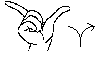 the hand-shape-sign:
Open between the index and the thumb upward,
showing the base shape
(人差し指と親指の間を開いて記号を象る)
the hand-movement-sign:
Draw the base shape in
one stroke (1筆に続けて書く)
(name): 
 [za] almost za of zigzag, but with the open
front vowel ( ザ )
[za] almost za of zigzag, but with the open
front vowel ( ザ )
ASCII: Y (the similar shape)
phonetic value:
[ z ]: voiced alveolar fricative (the base is the upside-down #65)
([ z ] #65を逆さにした対記号;上歯茎に舌先を近づけて出す摩擦有声音)
definition (single): plant (植物)
(verb):
main images in base overlays:
1) Related to a part of a plant (植物の部分にかかわって)
2) Related to a kind of plant (植物の種類にかかわって)
3) Related to a condition/growing process of some plant (植物の成長過程や育つ状態 )
4) Related to something mainly by/for 'plant' (植物による、または植物にちなむなにか)
5) Without relating to 'plant', to form picture-like fundamental characters
as a part of horn, face, nose and tentacles (角、顔、鼻、触覚などの象形基礎文字の構成)
examples of base overlay:
Related to a part of a plant (植物の部分にかかわって)
 {24(stable),66}: root (根)
 {{02,14}(hair),{24,66}(root)}: root hair (of plant) (根毛)
 {14(passage),66}:
stem (茎)
{14(passage),66}:
stem (茎)
 {14,{37,66}(tree)}: tree trunk ( not including elephant's ) (幹)
 {14,{37,66},{20(out)28}( surface )}: bark (樹皮)
 {{14,66}(stem),59( for the shape )}: bulb (球根)
 {63,66}( branched shape,
as a picture-like fundamental character):
{63,66}( branched shape,
as a picture-like fundamental character): {{63,66},10(place)}: branch (of office, etc.) (支所)
 {{63,66},{47,61}('foot' as a picture-like character)}: toe
(足の指)
{{63,66},{47,61}('foot' as a picture-like character)}: toe
(足の指) {{63,66},{46,63}('hand' as a picture-like character)}: finger (手の指);
 {{66,68(heart)}(as a fundamental
character): flower (花)
{{66,68(heart)}(as a fundamental
character): flower (花) {flower, 44
open}: blooming (開花)
{flower, 44
open}: blooming (開花) {flower, 43
closed}: bud (つぼみ)
{flower, 43
closed}: bud (つぼみ) {{66,68},28(sheet)}: a
petal/petals (花弁)
{{66,68},28(sheet)}: a
petal/petals (花弁)  {{66,68},16('powder' in this case )}: pollen (花粉)
 {{66,68},03 line}:
buth pistil and stamen (しべ)
{{66,68},03 line}:
buth pistil and stamen (しべ) {{66,68},03 line,19
female}: pistil (めしべ)
{{66,68},03 line,19
female}: pistil (めしべ) {{66,68},03 line,
20 male}: stamen (おしべ)
{{66,68},03 line,
20 male}: stamen (おしべ) {{66,68},26(gathering )}: a bouquet (花束)
 {{66,68},{02,26}(group in
one)}: a cluster of flowers (花房)
{{66,68},{02,26}(group in
one)}: a cluster of flowers (花房) {{66,68}(flower),59}: flower nectar/honey (花の蜜・蜂蜜)
 {66,67(life)}(a fundamental
character by the shape): fruit ; bear fruit/ bring
the result (v. with gd) (実)
{66,67(life)}(a fundamental
character by the shape): fruit ; bear fruit/ bring
the result (v. with gd) (実)  {{66,67},48(cover)}: peeling (果皮)
 {{66,67},59(liquid)}: fruit nectar (果汁)
  {{34,67}(meat),{(67),66}(fruit)}: flesh (果肉)
 {{66,67},58(possible, a part of 'adult')}: ripen (熟した)
 {34(important part),66(plant)}: a seed/seeds (種)
 {{34,66},48(cover)}: pod/hulls (豆・種の入るサヤ)
 {38,66}: sprout (by the total shape) (芽)
 {{38,66},{57(wonder),67(life)}(child)}:
baby (目立ったばかりの子ども:赤ん坊)
{{38,66},{57(wonder),67(life)}(child)}:
baby (目立ったばかりの子ども:赤ん坊) {19(female),66}: female plant (when differs are) (雌株の植物)
 {20(male),66}: male plant (when differs are) (雄株の植物)
 {37,66(plant)}(as
picture-like): tree (木)
{37,66(plant)}(as
picture-like): tree (木) {38(human growing){37,66}}:
forestation
(植林)
{38(human growing){37,66}}:
forestation
(植林) {{14,34},{37,66}(tree)}: bamboo (竹)
 {10(place),59,{37,66}(tree)}: oasis(オアシス)
 or
or  {10,{37,66}(tree),(26(group))}: forest(森)
  {10,37,66, 64(very)}: jungle(密林)
 {46(work),{37,66}}(wood for use): lumber/ timber (材木)
 {23,66(plant)}: grass (a fundamental character by
the shape) (草)
{23,66(plant)}: grass (a fundamental character by
the shape) (草) {38(raised by human),{23,66}(grass)}: green
vegetables (野菜)
{38(raised by human),{23,66}(grass)}: green
vegetables (野菜) {42(water- flowing, {23,66}(grass as a picture-like character)}: water grass (水草)
 {43(twine),66(plant)}(also this is a picture-like
character): vine kind of plant
like ivy (蔦など)
{43(twine),66(plant)}(also this is a picture-like
character): vine kind of plant
like ivy (蔦など) {{43,66},{37,(66)}(tree),{(66),67}(fruit)}: grapes (ぶどう)
 {{43,66},{14,(66)}(stem)}: vine (as the part) (蔓)
 {41(move),66(plant)}(because of animal-like and plant-like things):
protist (原生生物)
{41(move),66(plant)}(because of animal-like and plant-like things):
protist (原生生物) {42(water- flowing),66(plant)}: algae (藻)
 {66(plant),25(join)}(plants which join others to survive ): parasite(寄生植物)
 {12(the zigzag shape of the leaf ,66(plant)}: fern
(a fundamental character) (シダ)
{12(the zigzag shape of the leaf ,66(plant)}: fern
(a fundamental character) (シダ)  {{12,66},08(small)}: moss (by the similar system
to fern but smaller) (苔)
{{12,66},08(small)}: moss (by the similar system
to fern but smaller) (苔) {59,66}(a picture like character): wheat (小麦)
 {{59,66}(wheat).16(powder)}: wheat
flour (小麦粉)
{{59,66}(wheat).16(powder)}: wheat
flour (小麦粉)
 {40,65}(a picture like
character): rice (米)
{40,65}(a picture like
character): rice (米) {{40,65}(rice).16(powder)}: rice
powder (米粉)
{{40,65}(rice).16(powder)}: rice
powder (米粉) {40,65,34}:
crops (穀類)
{40,65,34}:
crops (穀類) {{33,66}:
beans/peas (by the shape; larger than usual seeds) (豆)
{{33,66}:
beans/peas (by the shape; larger than usual seeds) (豆) {{33,66}(beans),50}: bean product (豆製品)
 {{33,66}(beans),16(powder)}: bean powder (豆粉)
 {{33,66}(beans),16(ground),50(solid body)}: bean
curd/tofu (豆腐)
{{33,66}(beans),16(ground),50(solid body)}: bean
curd/tofu (豆腐) {17,66)}: growing (of plant), grow (vi. with gd) (成長)
 {18,66}: drooping, droop (vi. with gd: for plants), dejected (for human)
(しおれた、D動詞:うなだれる)
{18,66}: drooping, droop (vi. with gd: for plants), dejected (for human)
(しおれた、D動詞:うなだれる) {61,66}: growing thick (茂る状態)
 {62,66}: growing thin (痩せた、育ちが悪い)
 {ga (to change the meaning),38,66}: cultivated plant (栽培植物) {38,66} means 'sprout';
ga changes the
combination way)
{38,{23,66}(grass)}: green vegetables (栽培野菜)
{ga (to change the meaning),38,66}: cultivated plant (栽培植物) {38,66} means 'sprout';
ga changes the
combination way)
{38,{23,66}(grass)}: green vegetables (栽培野菜) {{38,66},09(intangible matter)}: cultivation (in this case,
#ga isn't necessary) (栽培)
{{38,66},09(intangible matter)}: cultivation (in this case,
#ga isn't necessary) (栽培)

 ge 38 31 {38,{23,66}}: cultivate greens
 {{38,09,66(cultivation), 65(occupation)}: farmer (農民)
 {66(plant),29} (chlorophyll in plants get this element
from air with sunlight): carbon (炭素)
{66(plant),29} (chlorophyll in plants get this element
from air with sunlight): carbon (炭素) {{03,29}(fiber),66}: plant fiber (with 66(plant)) (植物繊維)
 {66 plant,{47,67}
consumption}:
herbivorous/herbivore (草食)
{66 plant,{47,67}
consumption}:
herbivorous/herbivore (草食) {10(place),66}: the place for a plant (繁殖地)
 {10, {38,{66,23}grass kind}: vegetable patch (野菜畑、耕作地)
 {10,{38,66}(as a picture) sprout}: seed bed (苗床)
  {{33,23}(color),66(plant/ a part of 'grass')}: green (緑)
 {66,45(relation)}: breed/kind
(品種・種類)
{66,45(relation)}: breed/kind
(品種・種類) {28(sheet),66(plant)}:
paper (紙)
{28(sheet),66(plant)}:
paper (紙) {{28,66},26(gathering)}: notebook (帳面)
 {{47,50}(container),66}: plant pot/flowerpot (植木鉢)
Without relating to 'plant', to form a picture-like fundamental
character (象形基礎文字の構成)
 {60,66}(mammals honed head
shape): hone, threaten ( v. with #gd ) (つの);
{60,66}(mammals honed head
shape): hone, threaten ( v. with #gd ) (つの);
This character is used as a symbol of extension of human's
fighting power in a base overlay.
 {{60,66},21(go)}: threat (脅し)
 {{60,66},12(friction)}: collision (衝突)
 {{60,66},65(occupation)}: soldier (軍人)
 {{60,66},26(group)}: military (軍隊)
 {{60,66},26,12}:
war (戦争)
{{60,66},26,12}:
war (戦争)
 {{60,66},50(tool, goods)}: arms, weapon (武器)
 {{60,66,50}(arms), 64violent}: powerful weapons like missile or more (重兵器)
As the meaning of horns:
 or
or 
 horned: Trypoxylus/ rhinoceros beetle (カブトムシ属カブトムシ)
 or
or
 the right and the left (horns): Lucanidae/ Stag beetles (クワガタムシ科クワガタ)
 horn}: Caribou (トナカイ)
 large : moose (ヘラジカ)
 or
or  horn (having great horns): antelope (レイヨウ)
 or
(branch): deer/Cervidae (deer Family) (鹿/シカ科の動物)
or
(branch): deer/Cervidae (deer Family) (鹿/シカ科の動物)
 or
large: elk/Cervus canadensi (エルク)
or
large: elk/Cervus canadensi (エルク)
To shape a face with #15, #33 meaning of 'face' (「顔」の形の構成要素)
 {15,33,66}: face (as a fundamental character), represent
(v. with gd) (顔)
{15,33,66}: face (as a fundamental character), represent
(v. with gd) (顔)
 {{15,33,66},54(existence)}: representative (代表)
 {{15,33,66},44(opened)}: laughter, laugh (vi. with #gd)(笑い、D動詞:笑う)
 {{15,33,66},21(to)}: face to (対面、D動詞:向き合う)
 {{15,33,66},50(tangible thing)}: masterpiece (代表作)
 {{15,33,66},18(lower)}: chin (あご)
 {{15,33,66},17(upper)}: forehead (ひたい)
 {{15,33,66},{28,48}(wrapping)}: mask (仮面)
Shaping antennas/ tentacles of some animals
(アンテナ・触覚の象形)
 {39(sense),66}(like a picture, also with the meaning of
sensor :
{39(sense),66}(like a picture, also with the meaning of
sensor :
antenna/tentacle, sense through tentacles (v.
with #gd) (触角)
 {38(human-made),{39,66}}: antenna (アンテナ)
 {40,45,66}:
(looking like a insect): insect (wider meaning than Insecta) (虫: 昆虫綱より広い概念の設定)
{40,45,66}:
(looking like a insect): insect (wider meaning than Insecta) (虫: 昆虫綱より広い概念の設定)
 or
grass: Orthoptera/grasshopper (バッタ目(直翅目)、バッタ・イナゴ類)
or
grass: Orthoptera/grasshopper (バッタ目(直翅目)、バッタ・イナゴ類)
 or
tree: Cicadoidea/ cicada (セミ科セミ)
or
tree: Cicadoidea/ cicada (セミ科セミ)
{ (for the
shape),
(for the
shape), 
 main part of 'insect' symbol}: beetle (甲虫)
 {
{ sheet,
main part of 'insect' symbol}: butterfly (蝶)
sheet,
main part of 'insect' symbol}: butterfly (蝶)
Here are more varied
insect symbols with some illustrations.
 {{,
},
{{,
},
 child}: larva/larval (幼虫)
 or
or  cover}: pupa/chrysalis (さなぎ)
 {{,
},
{{,
},
 adult/mature}: imago (成虫)
 {67(life),24(hard)}(shell),66,45}:
crustacean (甲殻類)
{67(life),24(hard)}(shell),66,45}:
crustacean (甲殻類)
 {{67,24,66,45},{17,18}(symbolizing 'vertically longer')}: shrimp/prawn/lobster (エビ)
 {{67,24,66,45},{19,20}(symbolizing 'horizontally longer')}: crab (蟹)
Related to the nose and sense of smell, as its
shape of nose
(鼻の形との組み合わせで「鼻や匂い」にかかわって)
 {31,66}:
nose (a part of body where nostrils are; for any animals); breath through
nose (vi. with #gd) (鼻)
{31,66}:
nose (a part of body where nostrils are; for any animals); breath through
nose (vi. with #gd) (鼻)
 {{31,66},59(liquid)}: nasal mucus (鼻汁)
 {{31,66},{36,42}(sound)}: hum, humming (ハミング)
 {{31,66},14(way)}: nasal passage (鼻腔)
 {{31,66},39(sense)}: the sense of smell, smell (v.
with #gd) (嗅覚、D動詞:匂いを感じる)
{{31,66},39(sense)}: the sense of smell, smell (v.
with #gd) (嗅覚、D動詞:匂いを感じる)
Related to
scent/smell/odor (This part has been changed
since April 25, 2012)(匂いに関連)
(To see the symbols, please download and
install the EL font)
`YWO `scent/smell/odor
(匂い) {YW
nose (picture-like ideogram)(鼻)`O
`abstract concept, which works systematically}
`gYWO `emitting scent (放臭) {YWO
`g `open (開) }
`YWOa `: fragrance (花の香) {YWO
`aY `flower (花) }
`YWOQ `sharp odor (刺激臭) {YWO
`Q `shocking }
`YWOq `faint smell (かすかな匂い) {YWO
`q weak (弱)}
`OYWz `nasty odor (いやな匂い) {YWO
`z friction (摩擦)}
`YWOugp `sweet smell (甘い香) {YWO
`upOg `sweet}
`YWOh `chemical material of
scent (匂い物質) {YWO
`h `material }
`YWOK `source of odor (匂いの元) {YWO
`K `origin }
`YWO0 `odorless (無臭) {YWO
`0 `zero }
`YWOX `mixed odor (混合臭) {YWO
`X `piled (重なった)}
`nYWO `artificial scent (人工香)
{YWO `n `human
made (人工)}
`dYWO `incense (香料) {YWO
`d `goods(品)}
`YWOI `perfume (香水) {YWO
`I `liquid (液) }
`YWOr `the smell/fragrance
someone left behind (残り香){YWO
`r `behind}
.
 .
.
 .
.

