.
.
 .
.
 .
.
 .
.
 .
.

 .
.

Subject-Indicator / Two kinds
of Object-Indicators /Two kinds of Verb-symbols
/
Examples of various d-Verb phrases /
A predicate/verb with modifications /
Compounded verb symbols / Verb-bases
for answering questions
In an EL sentence, word order is free for subject (S), verb (V) and object (O) to make it easier and even for global communications. Instead, EL uses indicators as bellow to show which part of a sentence. English users might feel them as unnecessary; but this way is natural for visual thinking. E.g.: at anytime, the first person =
(when it's plural, the plural base is compounded on top); and you need not to memorize the declensions of pronouns such as I, my, me, we, our, us. Also the structure of a sentence becomes visually clear by this way.
 Subject-Indicator
 When the subject is at the beginning of a sentence or just after a special sentence indicator (for interrogative, imperative or exclamatory), this subject indicator is not necessary.
When the predicate, object or some modification comes before the subject of a sentence,When the subject of the interrogative sentence is the point of its question, you can answer, using only this indicator and the noun of the answer.
E.g.
Question: “Who did this?” Answer:(I did)
(
 (Accusative case indicator) and
  (Objective case indicator of
  -verb)
These two bases indicate different types of objective in a sentence, unrelated to each original image, only when they are used as single bases.
The EL verb system is unique and different from English or other languages; and the objective-indicators also follow the verb system, classifying into two kinds. But they are not as direct and indirect objects in English.
The examples of EL sentences with these indicators are in the verb section below.
-verb (close to causative verb in English). In the sentence, the subject lets/makes the
 (gd) and
(ge) : Two types of Verb-symbols
(gd) and
(ge) : Two types of Verb-symbolsAn EL verb/predicate always includes one of these verb symbols; so wherever you see them in, the group of ideograms is a verb/verb-related symbol or the predicate of a sentence.
An EL ideogram shows a noun or some kind of situation; also the bases and fundamental ideograms are simplified picture-like shapes or at least visually understandable shapes. A verb symbol change an ideogram or a phrase into a verb/predicate in a particular way, attaching in front of them.EL classifies the verb symbols into two types to make clear to which the verb situation/action actually belongs, to the subject or to the object of the sentence. They are not for transitive and intransitive verbs as English classifies. EL verb types are
The following are the reasons of the classification:1) Visually easy to understand
2) Small amount of simple ideograms systematically increase ability of expressions; and one can save his/her effort for memorization.
3) To make the context clear about whose action or situation is shown by the verb phrase.
4) Not only human centered, but also nature/things centered thoughts can go, and the custom might help to imagine others and co-work for our common environment.
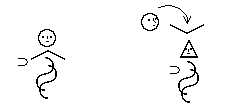
Diagrams about the relations between a verb and who actually acts:
E.g.:
itself means "eye" as a noun. Joining a verb symbol and
(1)
(Because of the-verb,
(2)
(Because of the: the object of
“you”)
(3)
(This verb symbol is passive, with: received; and this sentence does not mention about whose eyes, so we feel this as a general view.
: large power/strong)
The English words see, show and look, are in completely different spells, also originally are set as verb; and the definition of see doesn't care so much about with whose eyes. But these actions are all related to the eyes, so EL expresses all of these verbs by using
Derivatives ofor
: stare (the subject’s eyes work facing to a target)
or
: search (the subject’s eyes seek)
; or
: read (the subject’s eyes recognize)
: contact with eyes (the subject’s eyes contact …)
All these eyes are belong to the subject of these predicates, Because all areThese ways are applicable to systematically make verbs with the ideograms of other body organs and tools. More examples come later.
An ideogram for a condition or an action makes verbs more naturally with verb symbols
(it/that)
The left: The subject
The right: The subject/work
.
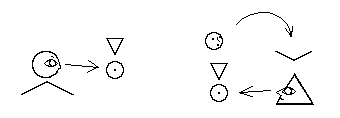
The left: The subject
The Right: The subject
The subject shows it to the indirect object."
-verbs/-verb
phrases
+ an ideogram/phrase of a situation, action or movement:The verbs in this case mean that the subject becomes the situation shown by the ideogram/phrase.E.g.
: become equal/even (
: equality,)
: a move)
: dance (vi ) (
energy-opened,
action}: a dance/dances)
: flow (vi.) (
waves, heading}: a flow/flows)

: This wine is made taking three years.
(: this (pointing at a close thing),
beverage,
: made (this ideogram means “made-situation”, so
means is made without taking the passive voice verb symbol.)
: with/joining,
: year as a period.)
Comparison:

(
: these (plural of
There is an empty space between
+ a fundamental organ/apparatus/tool
A living organ has more than one function, but usually a particular one is more distinctive than others. Eyes are mainly for seeing and ears are for hearing. Hands and feet do many things. In EL, an ideogram of a fundamental organ is used to form a verb meaning that the main function of the organ act/works.
(rationally) think (vi.) (
(leg/legs (picture-like fundamental symbol; the organ to support the body to stand),
+ a noun)
: foot/feet (by the shape),
Among many actions and functions of legs/feet, the above settings are ruled as the main action of basic legs/feet-verb.
To express other actions of legs or feet, you apply another or more base/bases to each symbol.Like these, you can easily find which phrase is the verb/predicate in a sentence.
Also depending on the verb symbol and the object indicator (
Since
(This legs are not the subject's, but belonging to the objectSometimes an ideogram of an organ of other animals or plants is also used to form a verb, symbolizing the human matter related to its function.
: threaten
Human doesn't have horns, but this verb can be used for human/human society's action.)
+ a fundamental organ/tool and a situation/action or a base
overlay of those
combination
Here are examples of more specific actions of feet and legs.
When
or
go}: walk (as the fundamental setting)
or
{feet go
or
or
{leg go
* Both feet and legs are actually needed to walk and to run. But the EL foot-ideogram is set for “walk,” and leg-ideogram is set for “run” in these combinations.
Tools are also involved to form a verb too, just as an extension of the body part.
or
: analyze with computer
({
separation,
recognition}: analysis
The computer belongs to the subject of this predicate and works by the subject)
: play music with strings
(The player is the subject of this predicate, and the tool:
strings works as an extension part (tool) of the subject.
{
space,
line}: strings
sound,
balance,
 ,
, and
,
, and
The phrase led by this mark is a modification phrase. It usually modifies the symbol/phrase in front of this mark. When you want to strongly stress the modification of a predicate, you can put it at the beginning of the sentence.
In this case the verb works like a transitive with
(him{
out/male}: the indirect object of the verb:
(
In this case, the analysis is not by me but my computer.)
{
preposition}: by/with/using)
If I feel my computer as a part of my body/brain, I can make this sentence even shorter:
(You need to put the subject indicator when putting the subject back from the front for emphasizing the object.)
*Direct English translations sound strange; but please think visually.
Verb symbols can be compounded with another base to change details of a verb, as a tense such as future, past, progressive form, continuation, experienced etc., or a nature such as negative, prohibition, passive, causative, possibility, wish, want, etc.
A multi-element compounded verb symbol is also available. The gd and ge page in the EL Dictionary shows many examples of compounded verb symbols.
If needed, more can be created.
For changing a verb into a noun
Compounding(an affair, intangible matter) on top of the verb symbol, the verb turns into a noun. Verbs of past, future or other occasion can be changed into a noun too by just compounding

({
long-continuation }: continuously doing thing,
{
(true): will come true
More examples are in the Dictionary site.
To modify another ideogram/phrase by a verb phrase:
Compound the preposition mark
: the people running at that place.
{
person,
plural}: people,
that (pointing a far place),
place}: at that place/there
{
past tense,
or
for answering questionsFor a question about the verb part of an sentence, wondering if it's right or not, EL simply answers using only the same verb base,to the next .To the top
andor
for “no”, denying the verb symbol.
Q:
A:
(: the front indicator of an inquiry sentence,
{
question,
(be going to) is the point of this question.
In English, you usually answer with a subject and an auxiliary verb matching to the inquiry sentence, but EL simplifies the answer as the verb base in the inquiry or denied that base, even if the verb symbol is multi-compounded.
Q:
({e-verb symbol,
The inquiry indicator and the position of
{
face as the fundamental ideogram,
A:
The answers can omit even the tense like these examples.
The inquiry sentence is an affirmative or a negative,
if the answer is affirmative, use
and if it’s negative, the answer is
Q:
A:
({
{
{
existence,
denied}: be not
{
The subject of last additional sentence is omitted, since the questioner knows it.)This simple answering system is planed for easy hand signing and clarity between cultures.
(Sometimes yes and no answers create a problem between traditional languages.
E.g.: the answer “Yes” for “Don't you know this?” means “I don't know” in Japanese.)