 .
.
 .
.
 .
.
 .
.
 .
.

 .
.
 Index of Grammar
Traditional languages usually each have an idiomatical polite way for a conversation; and others need time to learn about it, besides that language. If careless about it, friction could happen between cultures.
A common language, EL should avoid the problem, clearing the point of the purpose of a sentence to work with others.
Then EL idiomatically uses an indicator of joined characters at the beginning of a sentence to work with others.
English users might think them impolite through the direct translations. But simplicity and clearness are the polite and kind elements in the EL world, especially for EL signing.
Greeting
To work with others
To call other's attention . Interrogative types .
Imperative types . Exclamatory types
Answering, Appreciation, celebration, apology, etc.
Visual expressions
Honorific and despising expressions
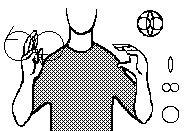
 : The almighty greeting symbol in EL
 : globe,
 : peace,{
 continuous, eternal,
  balance/harmonious}
is a spinning top shape balancing by always moving)
balance/harmonious}
is a spinning top shape balancing by always moving)The symbol,
Also this hand-sign or the vocal-symbol [bo-na-fee-na-wa] works for just a general greeting when you are going to pass by someone, as Hello, Good morning, Good day, Good evening, Good bye etc.
There are various direct meanings for a greeting word in the world, but most of them have a peace-sought image in the meaning. So EL is set similarly for the standard greeting.
Of course you can add or create your own expressions.
 to work with others at the beginning of a sentence
EL is free for word order in a sentence;
and an order of SVO, VSO or whatever order doesn't tell what kind of sentence.
Instead, idiomatic joined-characters distinguish kinds of sentences.
At the beginning of somebody's talking to you, you can know what kind he started to work with you for: asking, requiring, commanding or just getting your attention, etc. through a key ideogram between two
So you immediately know what the other wants at first, and you can ready to get the contents.

 : "Hey!" or "Attention please"
(39) means sense and feeling.
This base is for focusing any kind of sense of the other people (person) in this indicator;
as 'Attention please', 'Listen!', 'Look!', 'Touch and feel!', 'Smell!' and 'Taste!' or just 'Hey!.'
When calling a particular person (or people) with this, add the name or the substitute title in the beginning phrase. This phrase is an addition of a sentence, so even if the subject of this sentence is not at the beginning but next to it, the subject-indicator is not necessary.

: Hey, lady! you dropped something.
: {T < y } (a title of honor for woman},
: {t 1 }(dropping)
: {`; d ? }: something (a particular thing that the talker isn't sure what it is)
 : May I inquire you (something)?
has a similar shape to the traditional question mark, and it shows a wondering situation.
All interrogative sentences have this indicator,
Also the spot of the inquiry has another
Where, when, why, which way, what result, how much, how large, etc., all those interrogative ideograms include the base
The wondering spot in an inquiry is indicated by one of these interrogative characters or just putting
When wondering if it's true or not about a verb phrase in a sentence,
: she,
: be as existing,
The talker wants to know what she is. (The complement is the point of the question)
(The subject person is the point of the question)
(The verb is the point of the question, wondering if she is or not.)
: be as a condition; The talker wants to know her condition.
: which (among limited flowers),
: flower,
: liking, being fond of
( In this case, the direct object of the sentence shown byis the point of question.)
(among flowers without limits)
 at the end of a sentence: ..., isn't it? ..., didn't you?
As saying “It's one thirty now, isn't it?” or “You didn't go there yesterday, did you?”,
we sometimes describe our opinion first and ask others to make it sure.
For this type of interrogative sentence, the indicator is added at the end of a wondering sentence.
multiple
: (at) the time, then,
(the place in a topic): there
: past tense be; was (in this case)

: this (pointing close thing),
{denied "be"}: is/are not
:
Wondering to him/herself:Sometimes you might talk to yourself but to touch a chord with others around you.
In this kind of case, express your idea or wondering point first, and put this ending.
The ending pose shown by two dots makes us feel that the talker is not so confident on his/her idea.
(When the other knows about the situation, you need not all parts of a sentence in EL)
 ... : ( Could you ) please do (something)
has a shape of scooping to get something, meaning “demand.”
This joined characters indicator works for general requesting, forming an imperative sentence putting it at the beginning of a sentence. It is not especially polite, nor impolite.
For expressing the request more modestly or strongly as commanding, compound each meaning base on top of
For calling someone to request something, the manner is the same as “the indicator for attention.”
{this x place}: here,
: name
{being on a plane}: written, drawn
Could you please read this, and make me understand the contents?
: reading (recognizing through eyes),
: understood (recognition goes through),
: contents
To request from a little more humble standpoint:
 .....
:
.....
:
Could you do me a favor.....?, If you could, may I ask you....
Requesting something to someone who isn't expecting it, it would be better to do it with more modest manner. For this kind of case,
{action, move, energy-open}: dance,
{preposition mark, joining}: with,
: me (in this case, with
: open,
: that (pointing far something),
{eye of a room}: window
To command strongly:
 : This is a command, (do .....!)
Forcing someone to do something, the base,
(means power, force) is compounded on top of
{
torso,
upturn}: get up (with
)
: future tense verb-symbol,
{time x behind x be}: be late (with

 (or
(or  ): Let's.....
Here
(joined) is compounded on top of
The sentence with this indicator and the verb shows that the subject of this sentence is
not only you, The talker is joining you, and suggests doing something both together.
( the people who go are you and me together)
{heading + move}: go (with
{preposition mark, way}: through,
{going through place}: road
For suggesting a little more modestly or hesitate to suggest,
the hesitate and polite ending can be added, as same as a type of interrogative sentence.
Let's go through this road, or do you have any other ideas?
 : Ah! /
  : Oops!
In a conversation, sometimes an emotional sound comes up.
For describing it, expressing the sound part with the EL phonetics is one way.
By that way, it might be interesting to know differences of emotional sound between cultures.
But sometimes it would be hard to know each other’s feeling by that. When expressing using ideograms, these joined-indicators are used as below.
When these ideograms are at the beginning of a sentence between two dots, it works like an emotional voice or an exclamation mark. Read them in your traditional sounds.
Voices from happiness and from anger are different. When you’d like to distinguish the feelings of sounds, you can also use other–included ideograms as you feel. The ideograms related to emotions are in #68 section in the dictionary.

Ah..!, nobody can listen to this story without tears.
{verb-mark x possible}: can
{ears x accepted}: listen to (with
{flowing x contents}: story,
{preposition x not}: without
{eyes x water}: tears, weeping
Oh my god! At such a place like this, I'm seeing her!..Comparison:
The following sentence looks similar to the above example,
but the meaning is very different. In this case, the ideogram,

(There is no another dot for the indicator at the beginning.)


